
The Discovery of an Ancient Human
A Journey to the Centre of the EarthThis thread follows the discovery of human remains from initial astonishment through scientific interpretation and unresolved questions about the underground world.
increasing Bearing strength in each event
 decreasing
Bearing strength in each eventdecreasingA Bone Plain
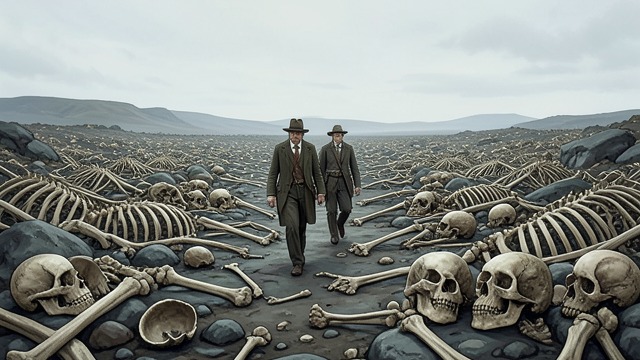
A Bone Plain
A landscape of remains
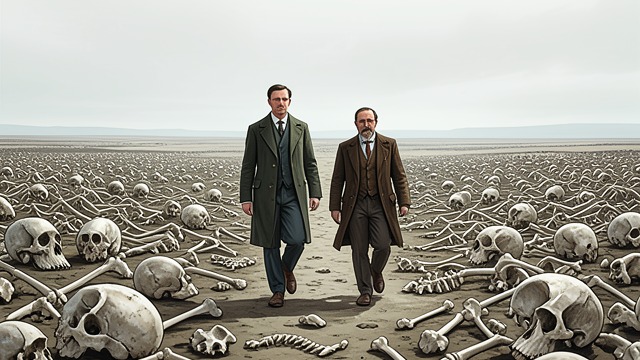
After leaving the shore, Professor Hardwigg and Henry cross an extensive plain covered with bones and shells. The remains belong to a wide range of ancient animals and suggest a natural archive gathered across long periods.
The scale of the deposit astonishes the Professor, who sees an opportunity to examine evidence unavailable in ordinary collections. The landscape transforms fossil study into a walk through accumulated geological history.
Anticipation of discovery
As they advance, the travelers expect further specimens but do not know what kind of evidence the plain may contain. Their curiosity pulls them onward despite the confusing terrain.
The fossil field prepares the narrative for a discovery that will challenge not only geology but the account of human antiquity.
The Human Skull
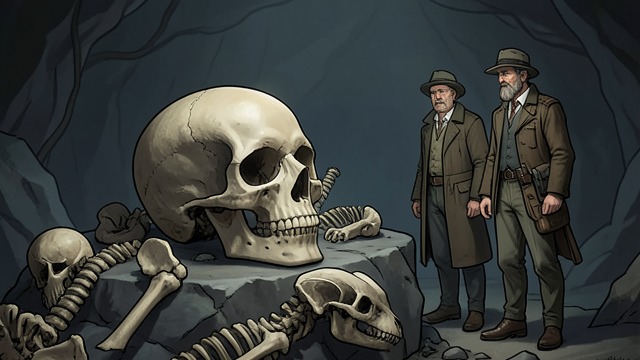
The Human Skull
A startling find
Professor Hardwigg picks up a skull and recognizes it as human. The discovery interrupts his examination of prehistoric animal remains and leaves both travelers astonished.
They find an apparently preserved body and consider it alongside the surrounding fossils. Its condition makes the past seem disturbingly close and visible.
A personal scientific triumph
The Professor imagines presenting the specimen to scholars who have disputed the antiquity of humans. The find seems to give physical authority to a question that had previously depended on contested fragments.
The discovery carries scientific importance and the emotional shock of encountering a human being separated from the explorers by immense time.
An Argument from the Body
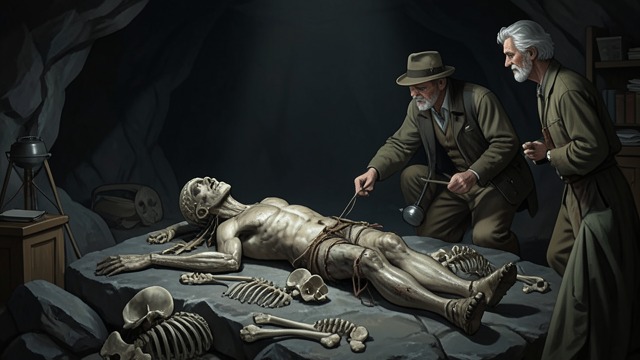
An Argument from the Body
The Professor interprets
Professor Hardwigg examines the body and declares it a human of the Quaternary period. He presents its apparent features as evidence for an ancient human population and connects the find to contemporary scientific disputes.
Henry listens as his uncle turns the discovery into a lecture. The Professor’s confidence is immense, but the preserved body’s presence does not answer every question about how it came to rest there.
Evidence and inference
Hardwigg acknowledges that the geological process that brought the body underground is not fully understood. His interpretation is therefore an argument built from observation, comparison, and conjecture.
The scene distinguishes the certainty of finding a specimen from the uncertainty of reconstructing its history.
The Larger Cemetery
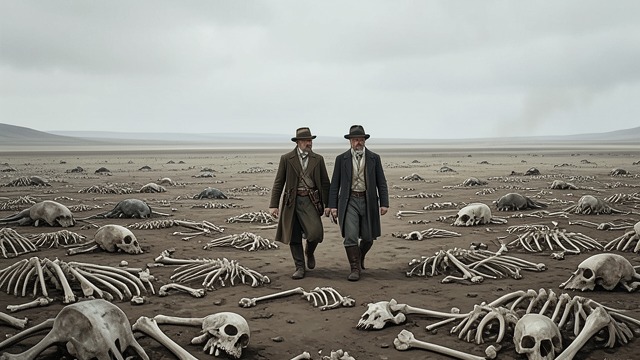
The Larger Cemetery
Remains gathered together
The travelers find other bodies and animal remains, establishing that the human specimen is not isolated. The plain contains evidence from multiple generations and kinds of life.
Its abundance makes the setting resemble a cemetery, though the travelers cannot determine whether these beings were buried by catastrophe or lived in the underground region.
An unsettling possibility
Henry wonders whether people might once have inhabited the subterranean world. That possibility raises questions about contact, survival, and the nature of the world below.
The fossil plain supplies evidence but leaves its most consequential interpretation open.
The Question Left Open
The Question Left Open
A discovery without a complete history
The travelers’ later encounters with ancient life make the human remains seem part of a broader underground world, but they do not prove that a human society exists there. Their most extraordinary sight, a giant herder among Mastodons, remains difficult for Henry to accept as literal.
The distinction between observation and explanation grows more important as the evidence becomes stranger. A human-shaped presence may have been seen, but its identity and relation to the fossil plain remain uncertain.
Science after astonishment
The travelers leave without resolving whether the remains record a catastrophe, an ancient population, or both. Professor Hardwigg’s public account makes claims, but Henry retains doubts about what can be known.
The discovery enriches their journey without supplying a final answer about humanity’s place in the underground world.
During the exploration after the party leaves the sea’s shore
When Professor Hardwigg first lifts the skull
During the Professor’s first address about the specimen
After the initial human specimen is found
After the encounter with the giant herder and before the final escape
